

Large diameter welded steel pipes form the backbone of water transmission, piling, structural, process and exhaust systems where a wide bore and long, consistent lengths are required. Produced by forming plate or wide coil and welding the seam, large-diameter welded pipe is usually made as longitudinal submerged arc welded (LSAW) pipe from plate, spiral submerged arc welded (SSAW) pipe from coil, or electric fusion welded (EFW) pipe, and is available across carbon, stainless and alloy grades to match different service conditions.
This guide reviews the typical size and wall-thickness range for large-diameter welded pipe, the factors that govern wall selection, and the main industries that rely on these pipes.
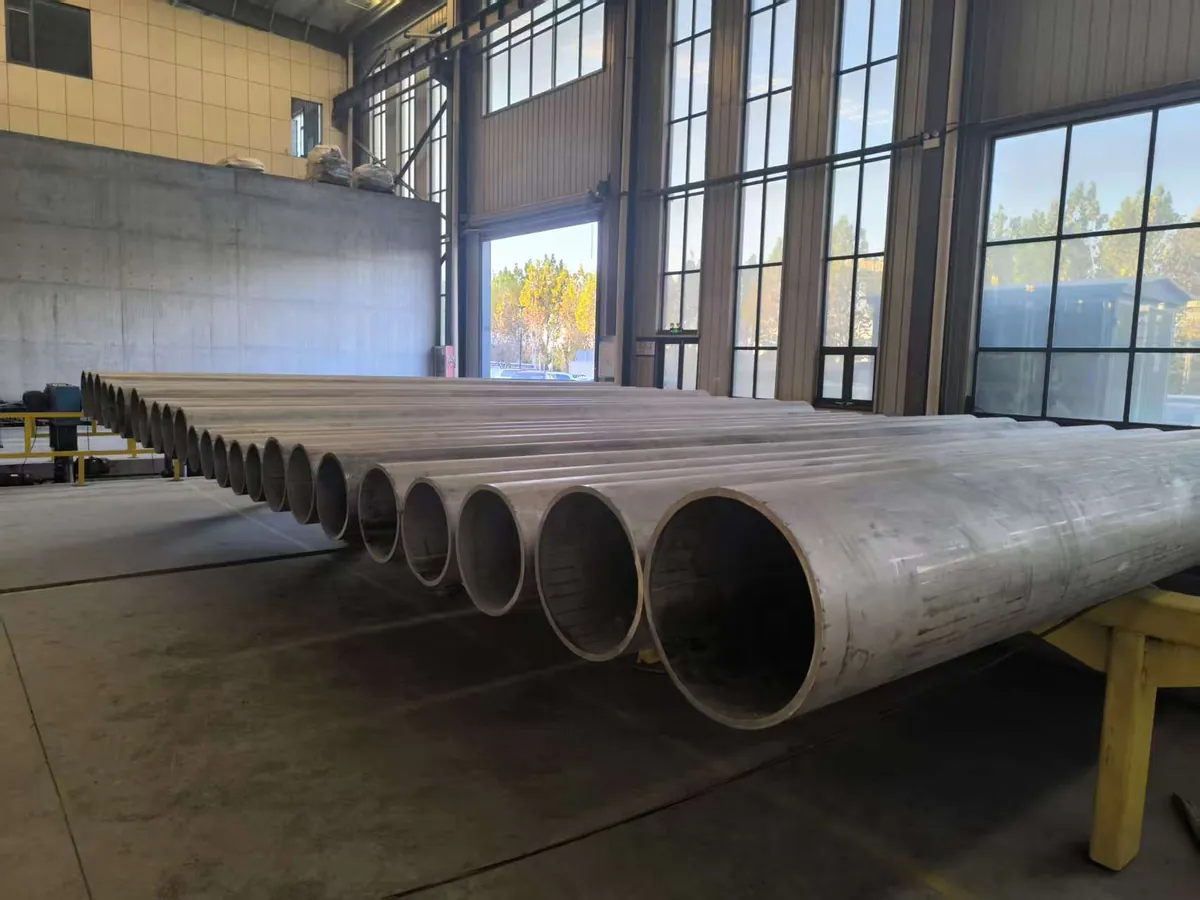
Table of Contents
- What Counts as Large Diameter Pipe?
- Common Sizes and Wall Thicknesses
- How Wall Thickness Is Selected
- Main Applications
- Dimensional and Weld Inspection
- Frequently Asked Questions
What Counts as Large Diameter Pipe?
There is no single universal cutoff, but in welded pipe practice the large diameter range generally covers pipes from roughly 500 mm (20 inch) upward, with extra-large sections reaching 1000 mm and beyond. The upper limit depends on the mill’s forming equipment, plate width, welding capacity and the agreed dimensional standard. Large-diameter welded pipe is normally supplied in fixed random or ordered lengths depending on transport and installation.
Common Sizes and Wall Thicknesses
- Outer diameter: available in both inch and metric sizes, expressed as nominal pipe size (NPS) or DN, or as a direct OD in millimetres; buyers often specify DN/OD for international orders, sometimes with a schedule number (Sch 40 or Sch 80).
- Wall thickness: ranges from thin-wall sections for gravity flow and ventilation to heavy-wall sections for pressure, piling and structural service.
- Grade: carbon steel for general structural and water service, stainless for corrosive or hygienic lines, and alloy grades for higher temperature or corrosion conditions.
Exact OD, wall and length should be stated on the enquiry, together with the applicable standard and tolerance, because large-diameter dimensions are more affected by forming and roundness control than small tubing.
How Wall Thickness Is Selected
Wall thickness is driven by internal or external pressure, soil and backfill loads for buried pipe, structural loads for piling or support, corrosion allowance, and the minimum wall required by the design code. Thin-wall sections suit non-pressure or low-pressure drainage and ventilation, while heavy walls are specified for pressure lines, piles and loaded structural members. Always carry out the pressure and structural calculation rather than choosing wall by rule of thumb.
Main Applications
Large-diameter welded pipe is used in municipal water supply and drainage, sewage and desalination, pipeline and process plants, oil and gas gathering, ventilation and exhaust ducts, building structural columns and bracing, pipe piles and sheet-pile-related works, as well as industrial infrastructure where a wide bore is required.
Dimensional and Weld Inspection
Large-diameter sections are checked for OD, wall thickness, length, ovality/roundness and straightness, and the longitudinal weld is inspected to the agreed NDT level. End preparation (bevel or plain end), protective coating and marking are often arranged at this stage. Confirm the inspection standard, certificate type and end finish when placing the order.
Frequently Asked Questions
Can large diameter pipe be supplied in stainless steel?
Yes. Large-diameter welded pipe can be produced in stainless grades for corrosive process, water and hygienic service, in addition to carbon and alloy grades. The available size range depends on the specific grade and mill capacity.
How are large pipes protected during export shipment?
Large pipes are commonly bundled or supported on saddles, with ends protected, surfaces coated or wrapped as required, and markings kept visible. Packing is arranged according to size, weight, surface finish and the destination route.
Which standards apply to large diameter welded steel pipe?
Carbon and line pipe are commonly ordered to API 5L or ASTM carbon standards, while stainless large-diameter welded pipe is ordered to ASTM A312 for straight-seam welded pipe or ASTM A358 for electric-fusion-welded austenitic pipe, with EN 10217-7 used for European pressure applications. The standard sets the weld process, NDT acceptance and certificate requirements, so it should be named together with the OD, wall and length.
Conclusion
Large-diameter welded steel pipe delivers a wide bore and long lengths for water, structural, process and industrial projects, with wall and grade matched to the load and fluid. Tell us your OD, wall, length, grade and standard through the contact page, and Shiwang Pipe will prepare a large-diameter welded pipe quotation.