

Duplex and super duplex stainless steel welded pipes sit between austenitic stainless steels and high-alloy nickel grades: they combine high strength with strong resistance to chloride stress corrosion, pitting and crevice corrosion. Where ordinary 304 or 316L tubes fail in seawater, brine, sour gas and chemical environments, duplex grades keep the pipeline reliable over a long service life.
In this guide we explain the most common duplex grades, how their microstructure balances ferrite and austenite, where welded duplex pipe is used, and what buyers should check before placing an export order.
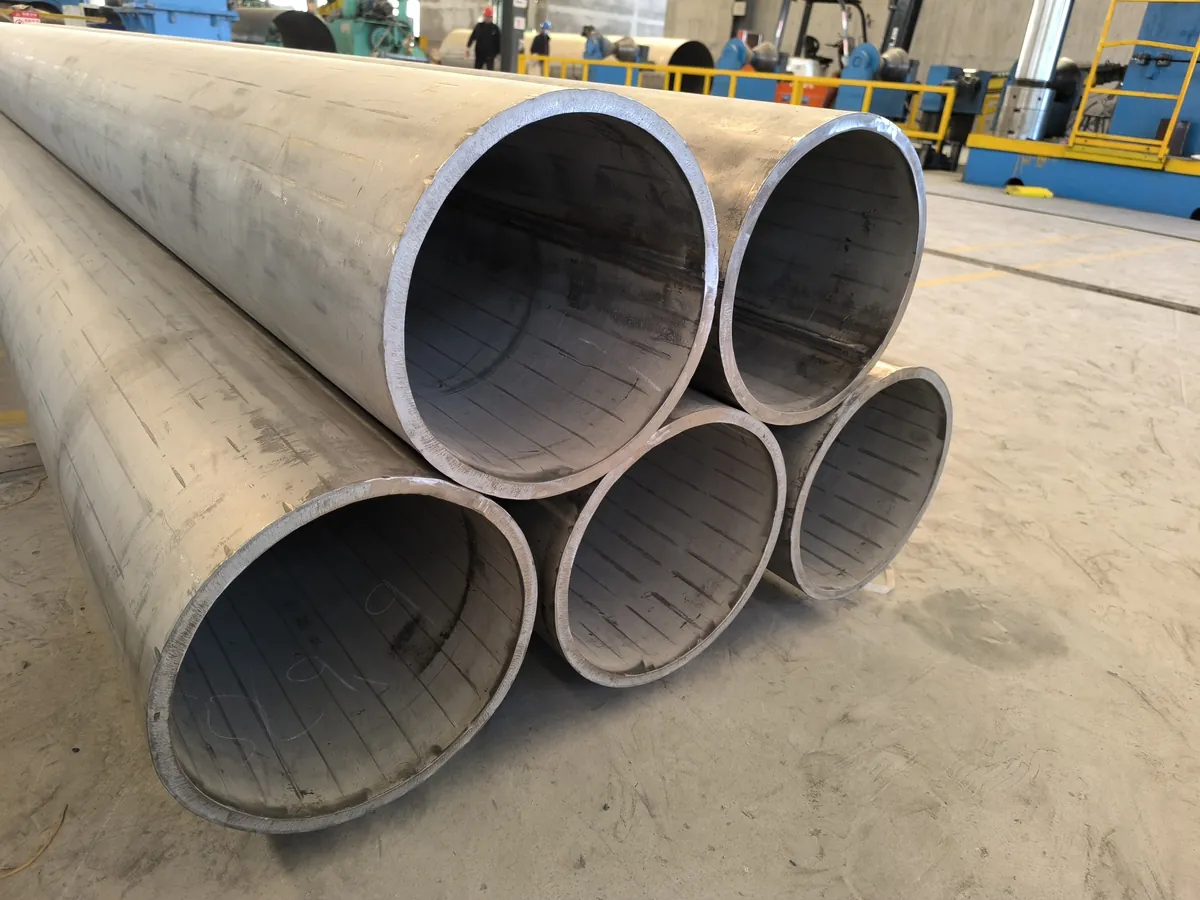
Table of Contents
- What Is Duplex Stainless Steel?
- Common Duplex and Super Duplex Grades
- Key Properties
- Typical Industrial Applications
- Welded vs Seamless Duplex Pipe
- Frequently Asked Questions
What Is Duplex Stainless Steel?
Duplex stainless steels have a two-phase microstructure made of roughly equal amounts of ferrite and austenite. This balance gives them the best characteristics of both families: the high strength and stress-corrosion resistance of ferritic steels, together with the toughness and weldability of austenitic grades. The ferrite-austenite ratio is controlled during melting, hot rolling and solution annealing, and it directly affects corrosion performance and mechanical strength.
Common Duplex and Super Duplex Grades
- Lean duplex (e.g. 2101, LDX 2101): a cost-effective grade for structural and general corrosion service, stronger than standard austenitic stainless.
- Standard duplex (e.g. 2205 / S31803 / S32205): the most widely used duplex grade, balancing pitting resistance, strength and price for process and marine pipelines.
- Super duplex (e.g. 2507 / S32750, Zeron 100 / S32760): higher chromium, molybdenum and nitrogen content for severe chloride, seawater and sour environments.
Grades are commonly referenced by UNS number, ASTM/AISI designation and the equivalent EN or GB grade on the purchase specification. Welded duplex pipe is ordered to ASTM A790 for seamless and welded duplex/super duplex pipe, or to ASTM A928 for electric-fusion-welded (EFW) duplex pipe with a filler metal, with EN 10217-7 used for European pressure duty. Sizes are given as NPS/DN with a schedule number (such as Sch 10S or Sch 40S) or as direct OD and wall thickness. Always confirm the exact grade, heat treatment and acceptance standard with the mill before production.
Key Properties
- Higher strength: duplex grades roughly double the yield strength of 304/316L, which can reduce wall thickness and weight in structural designs.
- Corrosion resistance: the PREN (pitting resistance equivalent number) rises with chromium, molybdenum and nitrogen; super duplex grades reach the highest PREN values in this family.
- Resistance to chloride stress corrosion cracking: duplex microstructure is far less susceptible to chloride SCC than single-phase austenitic stainless.
- Welding control matters: the weld and heat-affected zone must be controlled to preserve the balanced phase ratio; nitrogen shielding and proper heat input are commonly specified.
Typical Industrial Applications
Duplex and super duplex welded pipes are widely used in offshore and onshore oil and gas, seawater cooling and desalination, chemical and petrochemical processing, pulp and paper, fertilizer and chloride-handling equipment, as well as structural and marine construction. They are often selected when a 316L pipe would suffer pitting or SCC but a fully nickel-alloy pipe would be too expensive.
Welded vs Seamless Duplex Pipe
For many line-pipe and process-pipe applications, welded duplex pipe is a practical choice: it is available in larger diameters, with tighter wall-thickness control and a more competitive price, while the longitudinal weld is inspected to the agreed standard. Seamless pipe remains preferred for certain high-pressure or high-temperature service where the specification requires it. The choice depends on pressure rating, fluid, code and project inspection requirements.
Frequently Asked Questions
Is duplex welded pipe suitable for seawater service?
Standard duplex 2205 is used in many mild seawater and brine applications, while super duplex 2507 is typically specified for severe seawater, splash zone and sour service. The final grade should be selected against the actual chloride level, temperature and any sulphide present.
Can duplex pipe replace 316L in a corrosive line?
When 316L suffers pitting, crevice corrosion or chloride stress corrosion cracking, a duplex grade often provides the required resistance at a lower cost than a high-nickel alloy. The replacement should be confirmed against the process conditions and the applicable design code.
What is the difference between ASTM A790 and ASTM A928 duplex pipe?
ASTM A790 covers both seamless and welded duplex/super duplex pipe for general corrosive and pressure service, while ASTM A928 covers electric-fusion-welded duplex pipe produced with a filler metal and ordered by class according to the weld inspection level. Specify the standard, class, grade (2205 or 2507), NPS/DN, schedule and length on the enquiry so the weld and NDT requirements are clear.
Conclusion
Duplex and super duplex welded pipes offer a strong middle ground between standard stainless and expensive nickel alloys, combining high strength with reliable chloride and corrosion resistance. Whether you need 2205 line pipe or a super duplex grade for seawater service, contact Shiwang Pipe with your grade, size, wall thickness and inspection requirements, and we will prepare a suitable welded pipe quotation.